• Skip to primary navigation
  • Skip to main content
  • Skip to primary sidebar

Corpus Christi Watershed

Pope Saint Paul VI (3 April 1969): “Although the text of the Roman Gradual—at least that which concerns the singing—has not been changed, the Entrance antiphons and Communions antiphons have been revised for Masses without singing.”

  • Donate
  • Our Team
    • Our Editorial Policy
    • Who We Are
    • How To Contact Us
    • Sainte Marie Bulletin Articles
    • Jeff’s Mom Joins Fundraiser
    • “Let the Choir Have a Voice” (Essay)
  • Pew Resources
    • Brébeuf Catholic Hymnal
    • Jogues Illuminated Missal
    • Repository • “Spanish Music”
    • KYRIALE • Saint Antoine Daniel
    • Campion Missal, 3rd Edition
  • MUSICAL WEBSITES
    • René Goupil Gregorian Chant
    • Noël Chabanel Psalms
    • Nova Organi Harmonia (2,279 pages)
    • Roman Missal, 3rd Edition
    • Catechism of Gregorian Rhythm
    • Father Enemond Massé Manuscripts
    • Lalemant Polyphonic
    • Feasts Website
  • Miscellaneous
    • Site Map
    • Secrets of the Conscientious Choirmaster
    • “Wedding March” for lazy organists
    • Emporium Kevin Allen
    • Saint Jean de Lalande Library
    • Sacred Music Symposium 2023
    • The Eight Gregorian Modes
    • Gradual by Pothier’s Protégé
    • Seven (7) Considerations
Pew Book • Saint Isaac Jogues Illuminated Missal, Gradual, and Lectionary

Pew Book • Saint Isaac Jogues Illuminated Missal, Gradual, and Lectionary

To view sample pages, scroll
to the bottom of this page!

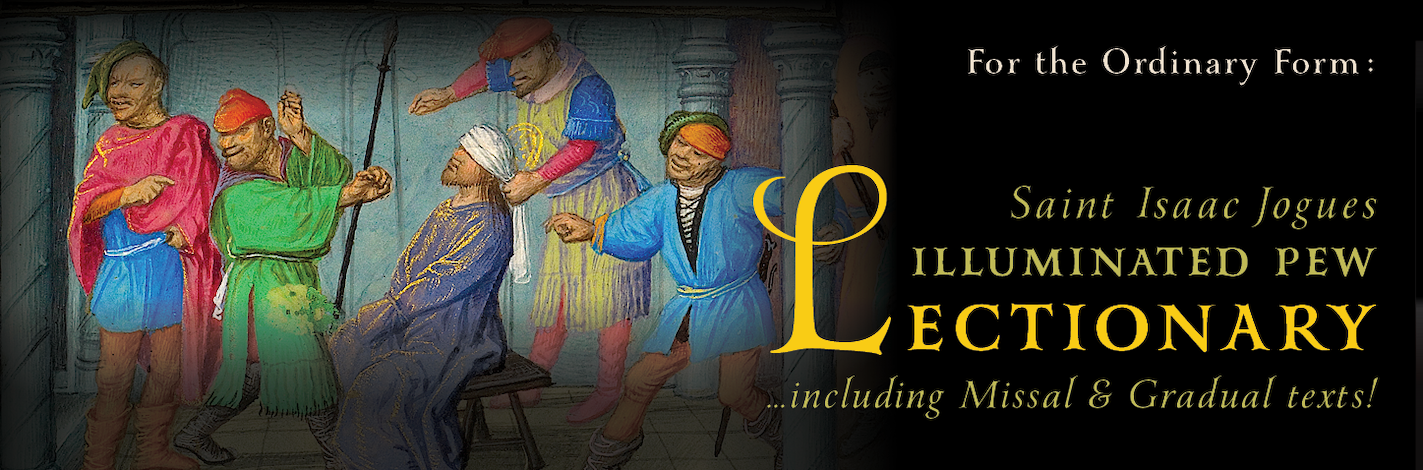
OPHIA PRESS INSTITUTE offers an exciting pew book for Ordinary Form which fulfills “the true liturgical vision of the Vatican II fathers.” This book is intended for the pews wherever Ordinary Form Masses are offered. By exploring the resources below, you can view sample pages, read reviews, and learn about the various elements that make this book’s 832 pages so unique. The official title is SAINT ISAAC JOGUES ILLUMINATED MISSAL, LECTIONARY, & GRADUAL, but it’s usually referred to as “The Jogues Missal.” This pew resource will last until the new Lectionary for the United States is released—which is scheduled to arrive in 2028.

*  Purchase • Jogues Illuminated Missal
—Contact SOPHIA INSTITUTE PRESS for bulk discount rates.


Questions?

Please contact Sophia Institute Press with questions about this excellent pew book.

+ Fact Sheet (PDF) • Overview on a single sheet of paper.

+ Special Home Video • How to open & use this book.

+ Table of Contents (PDF) • Familiarize yourself with the contents of this book.

+ Preface (PDF) • Should the Vatican II Gradual matter for today’s Catholics?

+ Congregational Mass Setting • Scores & Videos for organist, cantor, and SATB choir.

+ Gospel Acc. (1st Tune) • Download or buy all 172 pages!

+ Gospel Acc. (2nd Tune) • Download or buy all 172 pages!

+ Responsorial Psalms • Download or buy all 607 pages!

76855-Saint-Isaac-Jogues-Illuminated-Missal-Gradual-Lectionary
76858-Saint-Isaac-Jogues-Illuminated-Missal-Gradual-Lectionary
76857-Saint-Isaac-Jogues-Illuminated-Missal-Gradual-Lectionary

Essays & Reviews about the Jogues Missal

JOGUES REVIEW : Fr. Brent Maher

JOGUES REVIEW : Dallas Area Catholic (Blog)

JOGUES REVIEW : Christine Sarti

JOGUES REVIEW : New Liturgical Movement

JOGUES REVIEW : Fr. Alan M. Guanella

JOGUES REVIEW : Fr. Jay Finelli

JOGUES REVIEW : John Sonnen

JOGUES REVIEW : Susan Benofy (ADOREMUS)

JOGUES REVIEW : Melanie Bettinelli

JOGUES REVIEW : Daniel Craig

Essay 1 • Which antiphon translations are approved by the Church?
Essay 2 • How long will our current Lectionary translations last?
Essay 3 • Documentation on why Missal antiphons don’t always match the Gradual.
Essay 4 • The purpose of “sung” vs. “spoken” antiphons.
Essay 5 • Possibilities until the Sequences are revised by Liturgiam Authenticam.
Essay 6 • Musical collections of Propers in English.
Essay 7 • Clarity! • Missal vs. Gradual Text (Ordinary Form)

HE SAINT Isaac Jogues Illuminated Missal—now available from Sophia Institute Press—is for parishes seeking to move their community toward a more elevated, solemn, beautiful, and traditional celebration of the Ordinary Form of the Roman Rite. Designed to replace flimsy, disposable missalettes, the Jogues Missal brings together the rich texts of the Entrance, Gradual, Offertory and Communion chants along with the readings of the Lectionary, including responsorial psalms and Gospel acclamations. The Missal encompasses all Sundays, Holy Week, special solemnities, funerals, weddings, confirmations, and Benediction of the Blessed Sacrament. The preeminent highlight of the Missal, however, is the ORDO MISSAE, featuring full-color photographs portraying the various parts of the Mass. Sidebar explanations serve as a mini-treatise on the Mass, reminding the faithful that the Holy Eucharist is “the source and summit of the Christian life.”

*  Purchase • Jogues Illuminated Missal
—Contact SOPHIA INSTITUTE PRESS for bulk discount rates.

Primary Sidebar

Corpus Christi Watershed

President’s Corner

    PDF Download • “Quasi Modo Sunday”
    The Introit for “Quasi Modo Sunday” (12 April 2026) is particularly beautiful. The musical score can be downloaded as a PDF file, and so can the organ accompaniment. The official language of the Catholic Church is Latin (whereas Greek is our mother tongue). Vatican II said Gregorian Chant must be given “first place” under normal circumstances. As a result, some parishes will rightly sing the authentic version. On the other hand, because so many USA dioceses disobey the mandate of Vatican II, some musicians sing plainsong in the vernacular. I have attempted to simultaneously accompany myself on the pipe organ while singing the English version. Although very few take advantage of it, the complete Proprium Missae is posted at the flourishing feasts website.
    —Jeff Ostrowski
    ‘German’ Introductions for Hymns
    German organ books have an enchanting habit of including introductions for each and every hymn. For example, consider this snazzy example found in a German hymnal published in 1902. In the Saint Jean de Brébeuf Hymnal, that melody is called “Laudes Mariae” and was married to Omni Die Dic Mariae, with a popular English translation (“Daily, daily, sing to Mary”) by Father Henry Bittleston, an Oratorian priest. Notice they also added a ‘tailpiece’ or ‘playout’ or postlude at the end—a very German thing to do!
    —Jeff Ostrowski
    Buckfast Abbey Weighs In
    Dom John Stéphan was a Benedictine monk of Buckfast Abbey in South Devon, England. On 4 February 1933, he published this interesting letter in THE TABLET. Have you seen the exterior of Buckfast Abbey? It’s beyond gorgeous. I doubt there’s a more arresting Abbey in the entire world. Dom Stéphan’s letter is concerning this momentous collection, which our organization obtained, scanned, and uploaded.
    —Jeff Ostrowski

Quick Thoughts

    PDF • “Liturgical Law” (467 Pages)
    On Good Friday during the middle ages, the pope privately recited THE ENTIRE PSALTER. If you don’t believe me, see for yourself by reading this passage by Dom Charles Augustine Bachofen (d. 1943). His famous book—called “Liturgical Law: A Handbook Of The Roman Liturgy”—was published by the Benjamin Herder Book Company, which was the American arm (operating out of St. Louis, Missouri) of one of the world’s most significant Catholic publishers. Dom Charles Augustine Bachofen was born in Switzerland but spent his career between the Benedictine monasteries at Conception (Missouri) and Mount Angel (Oregon). His 1931 masterpiece, Liturgical Law can be downloaded as a PDF file … 467 pages!
    —Jeff Ostrowski
    “Gregorian Chant Quiz” • 24 March 2026
    How well do you know your Gregorian hymns? Do you recognize the tune inserted into the bass line on this score? For many years, we sang the entire Mass in Gregorian chant—and I mean everything. As a result, it would be difficult to find a Gregorian hymn I don’t recognize instantly. Only decades later did I realize (with sadness) that this skill cannot be ‘monetized’… This particular melody is used for a very famous Gregorian hymn, printed in the LIBER USUALIS. Do you recognize it? Send me an email with the correct words, and I promise to tell everybody I meet about your prowess!
    —Jeff Ostrowski
    PDF Download • “Ubi Caritas” (SATB)
    I remember singing “Ubi Cáritas” by Maurice Duruflé at the conservatory. I was deeply moved by it. However, some feel Duruflé’s version isn’t suitable for small choirs since it’s written for 6 voices and the bass tessitura is quite low. That’s why I was absolutely thrilled to discover this “Ubi cáritas” (SATB) for smaller choirs by Énemond Moreau, who studied with OSCAR DEPUYDT (d. 1925), an orphan who became a towering figure of Catholic music. Depuydt’s students include: Flor Peeters (d. 1986); Monsignor Jules Van Nuffel (d. 1953); Arthur Meulemans (d. 1966); Monsignor Jules Vyverman (d. 1989); and Gustaaf Nees (d. 1965). Rehearsal videos for each individual voice await you at #19705. When I came across the astonishing English translation for “Ubi Cáritas” by Monsignor Ronald Knox—matching the Latin’s meter—I decided to add those lyrics as an option (for churches which have banned Latin). My wife and I made this recording to give you some idea how it sounds.
    —Jeff Ostrowski

Random Quote

“I have, on the other hand, retained several more or less traditional tunes, absolutely valueless and without merit from a musical point of view, but which seem to have become a necessity if a book is to appeal—as I hope this one will—to the varied needs of various churches.”

— A. Edmonds Tozer (1905)

Recent Posts

  • PDF Download • “Quasi Modo Sunday”
  • ‘German’ Introductions for Hymns
  • Fascinating Interpretation of the “Regina Caeli” (Solemn Tone)
  • PDF Download • “Sprinkling Rite” + Psalm Verses
  • Buckfast Abbey Weighs In

Subscribe

Subscribe

* indicates required

Copyright © 2026 Corpus Christi Watershed · Isaac Jogues on Genesis Framework · WordPress · Log in

Corpus Christi Watershed is a 501(c)3 public charity dedicated to exploring and embodying as our calling the relationship of religion, culture, and the arts. This non-profit organization employs the creative media in service of theology, the Church, and Christian culture for the enrichment and enjoyment of the public.